
I used to believe that creation vs. evolution was one of the most important topics of Christianity. Now I believe it is more of a distraction. It is extremely divisive and antagonizing, and its discussion hardly ever seems to bring about any good fruits. That being said, it has been important for me personally to be convinced in my own mind what I believe about the origins of life—and for this reason, I have spent some time exploring and reflecting on this topic.
A theological approach. I am a theology and sociology major—not a scientist. The purpose of this post is not prove or disprove anything in scientific terms, but to address a much more fundamental aspect. I want to look at some of the philosophical and theological principles and beliefs that are necessary in order to consistently and fruitfully navigate the question of creation and evolution. Besides that, I also want to lift up a more nuanced view than what I feel is often presented by on each side of the question.
The comments of the Adventist pioneer Ellen White on the topic of education, science and the Bible have been a major inspiration to me. She claimed that while there might seem to be contradictions between Scripture and the natural sciences, these apparent contradictions stem from our own ignorance and the misguided inferences drawn from the actual evidence. The Adventist emphasis on education and critical, independent thinking, and on nature and the Bible both being revelations of God and truth, has encouraged and inspired me to more independently explore the issue for myself in the limited capacity that I have as a theologian (and not a scientist).
These are my own observations so far.
An inevitable question of faith. Early on in my exploration, I realized that I had to acknowledge to myself where my basic trust lies when my own understanding, education and experience fall short. As for all the truth claims that I cannot personally verify, test or comprehend using my own abilities, who and what do I fundamentally trust and implicitly believe to be closer to the truth? Do I place my fundamental trust with the scientists? Do I place it with the Church? The Bible? My social circle?
My first acknowledgment: Most of the so-called knowledge that each and every person possesses is based on trust, not personal experience or observation. We trust our teachers, the journalists, the authors who wrote the books that we read, the professionals and experts, and we trust in society at large in various other ways. We trust others with our very own lives—doctors, bus drivers, pilots—the list goes on. None of us have personally verified or reasoned out every piece of information that we’ve come across. At times we might critically question what we read or hear—but this we do by measuring a dubious claim up against what other more trustworthy sources say. Using our limited reasoning capabilities, we make pre-judgments of what seems likely to be true. We accept or reject the information we come across based on our own more or less reasonable and subjective, often instinctive and subconscious assessments. The question of truth is inevitably tied to the question of trust or faith—whether we are aware of it or not.
My second acknowledgment: Following my powerful spiritual experience as a teenager through Christianity, and my personal and academic studies of the Bible, the biblical prophecies, and of philosophy and human history as an adult, there was no doubt in my mind: What Christians refer to as God is real. The Divine has manifested itself in our human history (of which the authors of the Bible give an account), and the Bible as a written work bears the imprint of a divine, multi-layered genius, logic, mind and coherence behind the imperfect and often chaotic human agency and history. My experience and observation, though limited, generates the conviction that the principles and ideas conveyed in the Bible, despite possibly being misrepresented and insufficiently understood, hold important, practical truths about God that are for our own benefit.

Trusting the Bible. Thus, I had to acknowledge that my basic trust in God and in the Bible is greater than my trust in the shifting theories of the natural sciences. Oftentimes has scientific research uncovered new evidence that changed their models, explanations and history timelines. And on several significant occasions have scientific discoveries confirmed what was once only regarded as biblical myth (I’ve been quite fascinated with this quite recent discovery).
The unchanging words of the Bible have on the other hand brought a richness of meaning and wisdom and life-betterment to human beings over thousands of years. Prophecies uttered thousands of years ago concerning the Messiah, the world kingdom, and the end of the world, find and continue to find curious matches and fulfillments in the work of Jesus Christ and in the social and political developments of our world ever since. The messianic prophecies’ fulfillment in the life of Jesus, the prophecies of the world kingdoms found in the Old Testament, and the prophecies of the end-times in the New Testament, are to me outstanding evidence of a divine genius that can be scrutinized and tested against the history books. I’ll save this for another post.
However, to me personally it is the goodness and wisdom manifested in the life and message of Jesus Christ that serves as the greatest proof of the genuineness of the Bible. Jesus as a historical person is simply outstanding and serves as a fitting and inspirational role-model for any human being, as he also has been for important historical figures such as Martin Luther, Mahatma Ghandi, Martin Luther King Jr., Sir Isaac Newton, William Wilberforce, Leo Tolstoy, Nelson Mandela, Florence Nightingale, Blaise Pascal, Dietrich Bonhoeffer, Fyodor Dostoevsky, and others.
To me, the most important questions to ask concerning the origins of life are therefore the following:
- What does the Bible really say (and not say) about the origins of life?
- How do scientific observations of evolution fit into the biblical worldview?
The Creation account. Firstly, it seems evident to me that the creation accounts written in Genesis 1 and 2 were intended to be read as literal, historical events, not merely as allegory. Merely, I say, since the apostle Paul does indeed affirm that Bible history also can have allegorical significance, in addition to its historicity (Galatians 4:24). The Sabbath commandment and the seven-day week as established out by God to Moses in the Ten Commandments implies a literal understanding of the time span given in the creation account (Exodus 20:1-17).
However, the evidence of an evolutionary process in nature as studied and documented by scientists such as Charles Darwin is undeniable. The process of natural selection and change in the attributes of species over time is observable today and is also clearly seen in the fossil record. How do I make sense of these two testimonies, of the biblical record of creation and of evolution?
General/natural revelation. I had previously thought little of how the Bible portrays God as a Creator who is constantly present and at work in nature and manifesting Himself through nature (Romans 1:20; Colossians 1:13-17; Matthew 6:25-30; Psalm 104; Psalm 19:1-6; Psalm 147:7-9; Job 12:7-10). This, I thought, was merely a poetic, allegorical way of saying that God is the First Cause of everything.
It was, however, the thoughts of Ellen White that made me realize that this is not at all what the Bible is saying. In the Bible, nature is intentionally presented as being under God’s constant and incessant control. God is not portrayed only as the First Cause of everything; He is portrayed as being constantly active in and through nature to keep it running moment by moment. The assumption that God after having created the world mostly doesn’t interact with it (deism) is a deeply unbiblical belief. However, the opposite assumption—that God and nature are one and the same (pantheism)—is also deeply unbiblical, as God explicitly forbids the worship of nature.
The Familiarity Bias. What does it then mean that God works in and through nature? It means that the energy and fundamental forces active in nature should from a biblical standpoint not be viewed as blind, mechanical forces that are inherent to nature itself. Rather, they are manifestations of God’s presence and activity. God is constantly and miraculously exerting His power and energy in order to uphold the universe second by second. This is an immense and unfathomable thought! In Christian theology, nature is referred to as God’s natural or general revelation of Himself because it is a manifestation of God’s power, presence and mind that is universally available and evident to all. The ordered existence of the universe, the healing of a wound, the beating of the heart, the movement of the stars and planets in their set courses, all following ordered and logical laws, are no less miraculous than the resurrection from the dead. It is just a matter of perspective. In Western scientific thought, many assume that nature’s laws and forces are inherent to nature and no evidence of the existence of the divine. But the Familiarity Bias teaches the we humans tend to undervalue, even though it might be important, profound or significant.
Perhaps we are just so used to nature running its course that we take creative power for granted? Perhaps we are so used to God’s work and presence that we don’t recognize it for what it truly is?
Natural selection. If God truly is present and manifests Himself through the laws of nature, this must also include the observed law of natural selection, or “the survival of the fittest”. This law, which logically must be a part of God’s own law, is an ingenious way of ensuring the continued adaptation and survival of life in the face of environmental change and difficulty. It ensures the preservation and continuation of life itself.
When Christ (good) is described as triumphing over the Devil (evil) in the Bible, this is also in accordance with the law of natural selection. The principles of Christ (truth, love, unselfishness, omnipotence) are superior or more viable or “fit” for survival than those of Satan (falsehood, hatred, selfishness, limited power or impotence). The principles of the Devil may seem superior through falsehood and pretense, but are ultimately self-destructive in their effect because they are not in line with the universal laws governing life, health and development.
Hence, we see that the law of natural selection that drives evolution is not merely a blind mechanism driven by chance as many Christians argue, but rather is a manifestation of God’s wisdom, control and providence being constantly at work in nature.
However, while nature and the law of natural selection testifies to divine “fitness” and life-energy in nature, it also manifests another power at work in nature—the power of “unfitness”, decay and death. This, the Bible teaches, is not God’s doing or work, but is the work of God’s opponent, the Devil. I’ll get back to this later.
Special revelation. Does God’s general or natural revelation of Himself exclude the possibility of Him (as an Intelligent Creator with intelligent creatures) choosing to reveal Himself in more special ways? Of course not. Special revelation signifies in Christian thought what we call the “supernatural”, extraordinary or personal ways by which God manifests Himself. The Scriptures written by prophets or God’s spokesmen claim to be special and personal revelations of God to mankind. The most personal and clearest way God has revealed Himself to us as personal beings the Scriptures say is through His incarnated Son, Jesus Christ.
God’s natural revelation and God’s personal revelation cannot contradict each other since they come from the same divine Source. Nature and Scripture cannot in reality contradict each other, even if they may seem to do so from a human standpoint. If we carry over this principle to the question of the origins of life: While the natural, ordinary processes such as natural selection are real and evident from scientific research, these mechanisms do not provide any compelling reason to deny God’s ability to create life through more extraordinary ways as described in the Bible—such as through more personal, quick interventions. This is clearly what the creation accounts of Genesis 1 and 2 teach—that life did not emerge naturally over time the same way God controls nature today, but rather by God’s personal and sudden intervention.
If the same God has revealed Himself through nature and through Scripture, these testimonies cannot contradict each other, but must in reality agree and affirm each other. The creation account in the Bible and the evolutionary processes observed in nature must both be upheld as valid and true in their true sense and meaning. The question is: What is their true sense and meaning? How should they be interpreted?

God’s creative intervention. The creation account describes God’s persona, direct and extraordinary intervention to create life on this planet. God forms the man of dust, breathes into him the breath of life, and man becomes a living nephesh, which is Hebrew for “soul” (Genesis 2:7). God is not a mere force working through nature; God is presented as a personal Being who, like a master Artist, creates other personal beings. God also forms the animals of dust (Genesis 2:19). These descriptions seem to indicate that God chose to create life on this planet through personal, supernatural intervention rather than by natural law. This to me seems to be the true sense and primary meaning and message of Genesis. God is a personal Being, and we as personal beings are made in His likeness by His personal choice and intervention.
Some Christians assert that the Genesis account addresses the creation of the entire universe. However, the book of Job mentions that other beings already were in existence when “the foundation of the earth” was laid—namely, the “morning stars” and “sons of God” (Job 38:7, ESV). The creation account in Genesis also mentions a time period before earth’s creation when the earth was empty and covered in darkness (Genesis 1:2a). Besides, the story of the cherub Lucifer’s rebellion, fall, and his transformation into Satan must have taken place before he in the form of a serpent could tempt Eve to sin (Isaiah 14:12-17; Ezekiel 28:12-19; Revelation 12:7-9). These passages indicate that the creation of the whole universe and the creation of the earth were not to be taken as part of one and the same creation event. It is not necessary to hold this view, as some Christians teach, in the face of scientific deductions of an ancient universe. The purpose of the creation account in Genesis is to explain the divine origin of the world that we humans live in.
However, while the theory of evolution claims that advanced forms of life originated and evolved from microscopic amoeba over millions of years, the Bible on the other hand claims that advanced forms of life were created and planted on the earth through divine intervention over the short time span of six days. These two claims cannot both be true. And this is where I must choose: Whom do I trust?
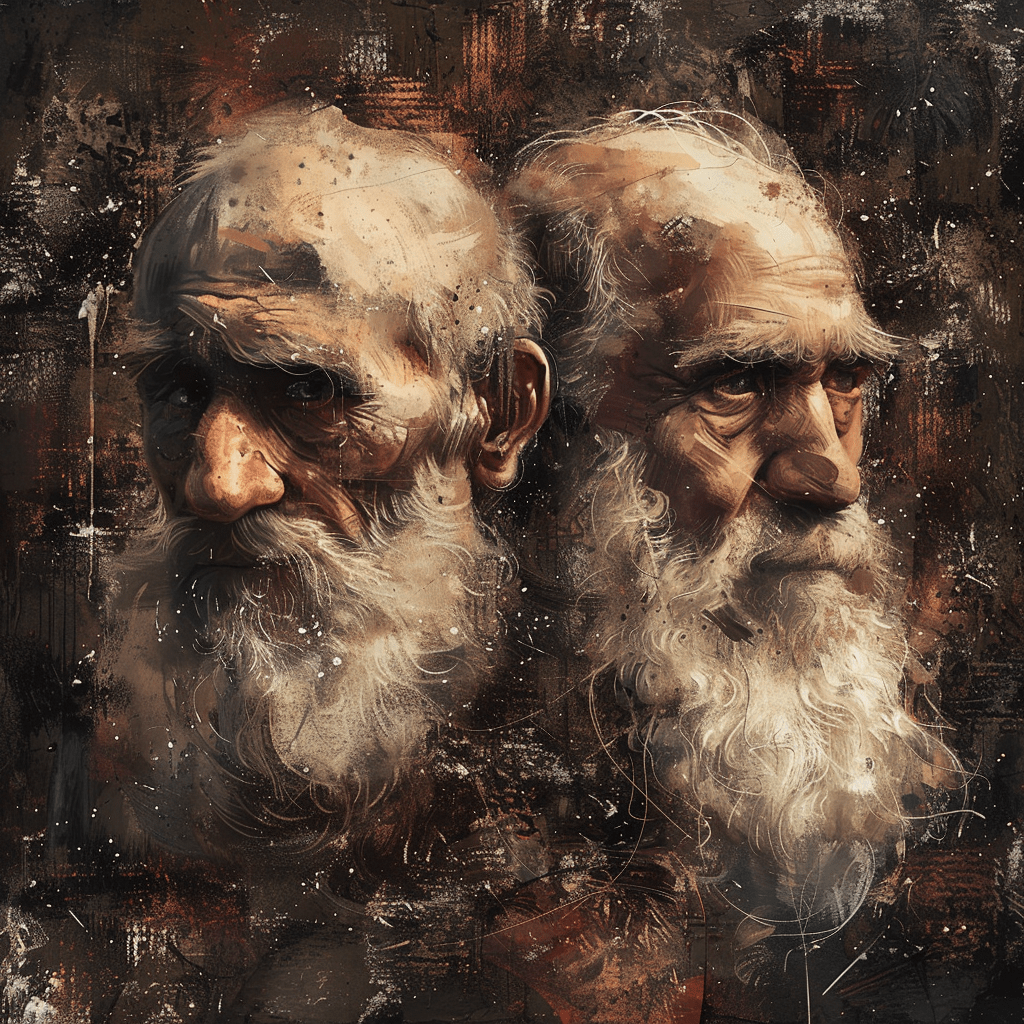
The God of Darwin vs. the God of Genesis. Darwin’s theory of the origins of life holds that death always has been a central part of existence on this planet, since the very beginning. Darwin claimed that it was through the suffering and death of billions of organisms, creatures and animals that the world and human beings have emerged. The Bible, on the other hand, plainly states that in the beginning when God created our world, death and suffering didn’t exist (Genesis 2:17; 3:19; Romans 5:12-21). In Genesis 1, God pronounces His creation to be good seven times, indicating divine perfection. Now, death and decay is a part of our world, and our world can hardly be described as being perfect. The apostle Paul explains this by explaining how God allowed creation to be subjected to decay and death because of sin (Romans 8:20-21). God allowed death and suffering to enter the world, contrary to His own will or intention, when mankind made the choice to start sinning. Sin is breaking the laws that govern order and life, and therefore sin naturally and by itself brings suffering and death as a consequence. However, death is an enemy that in the end when sin will be uprooted, will be destroyed by God (1 Corinthians 15:26; Revelation 21:4). Death will once again cease to exist.
These texts are at odds with Darwin’s theory, which, based on how nature works now, views death and suffering as an integral part of the origins of life. This is the assumption that the world and nature as it is now reflects how it always has been. According to the Bible, however, death had no part in God’s work in the beginning, but came into the world as a consequence of mankind’s destructive, lawless actions. This means that nature no longer gives a complete and accurate revelation of God’s work since the lawless actions of humankind have stained our world and brought death and suffering into all parts of it, contrary to God’s will and intention. While God’s benevolence, intelligence, and power still are visible in nature, another power is now also visibly at work: The power of chaos, disease, suffering and death. This power is not divine or from God, but is the visible effect of sin and the breaking of the laws of God by mankind’s abuse of their God-given freedom and powers.
A question of God’s character. Darwin’s and Moses’ teachings on the origins of life come with huge theological and moral implications. What is God’s character like? What kind of God is He? There are important moral lessons in each view. Is the Creator the Author of suffering and death in our world? Is the suffering and death of humans and animals God’s own plan and will? Is suffering and death a divine invention forced upon us in order for His plan for creation to be realized? In Genesis the clear answer is no—suffering and death are not God’s will. They are not part of God’s design or intention for His creation. According to Darwin’s theory on the origins of life, however, the answer is inevitably yes—God as the Creator is indeed the inventor of suffering and death as His tools to perfect His creation. Before mankind could make any moral, free-will choice, we and all creatures were subjected to a life of suffering, disease, conflict and death. (Note: Darwin was not an atheist, but believed in God as being the First Cause of the universe and of evolution when he wrote The Origin of Species. He was a Deist.)

While the Bible teaches that suffering and death are not God’s will or creation, the Bible also says that God has allowed suffering and death to enter the world as a consequence of humanity’s free choice. To claim that God arbitrarily decided suffering and death to be a part of our earthly existence regardless of our own choice is to give God the ultimate responsibility for suffering and evil. This not only denies human free will, but is also absurd and non-sensical. Why would an omnipotent Creator choose to create humans and animals to suffer and die? This is what Darwin’s theory implies.
Making sense of suffering and death. To me, the trueness of each theory of origins hinges on how they theologically and morally make sense of suffering and death. Would a good and all-powerful Creator design His creatures to suffer and die in order to evolve His creation? As I see it, a God that makes sense and is benevolent is only feasible by viewing suffering and death, not as God’s invention or will, but as the result of our human free will. In the Genesis account, God is portrayed as desiring to spare humanity from the pain of knowing evil; He forbids mankind from eating of the tree of knowledge of good and evil (Genesis 2:16-17). However, mankind freely chooses to disobey God and acquire this knowledge for ourselves (Genesis 3:6), making evil and its train of suffering and death a part of our world and human experience.
Jesus’ parable of the weeds. In the parable of the weeds recorded in Matthew 13, Jesus compares the world to a wheat field filled with weeds. He portrays evil in our world as weeds that were planted, not by the farmer himself (God), but by an enemy (the Devil). Yet, to protect the good wheat from being uprooted with the weeds, the farmer chooses not to immediately uproot the weeds, but allows the weeds to continue to grow together with the wheat. The lesson in this parable is that good and evil are intricately and inseparably connected in our world now. If God removed all that which is evil immediately and abruptly, some of the good would be harmed and destroyed. In order to spare that which is good, God waits for our world to mature and develop to the point where He can safely remove all that which is bad without harming the good. God is presented as a Farmer, as a good Creator and Restorer. God’s enemy (free-will beings who choose to rebel against His laws governing the universe) is portrayed as the destroyer of God’s creation.
While the evolutionary mechanism of natural selection and survival of the fittest is an integral part of our natural world today, this law of survival would logically lay dormant if all “unfitness” and competition of resources and mortality were eradicated from our world. There would be no competition or conflict, because there would be no threat or fear of death. Such was the world that God created in the beginning, according to Genesis, and such will the world be when God restores it according to the book of Revelation. While the mechanism of natural selection indeed explains the immense diversity that has emerged over time since creation, I don’t think it is morally satisfactory as an explanation of how life first originated on earth. The Bible teaches that advanced forms of life were created and planted on this planet in the beginning. Since these first “prototypes” were planted, they have evolved and adapted through processes like natural selection to the changing environments on this planet.
But what about the age of the earth?
The uniformitarian assumption. The dating method applied in geology, radiocarbon dating, is based on the assumption that the production of radiocarbon in our atmosphere has been at an equilibrium for millions of years. Radiocarbon dating involves measuring the amount of remaining radiocarbon in fossils. Radiocarbon is continuously being produced in the earth’s atmosphere by the interaction of cosmic rays with atmospheric nitrogen. Plants absorb radiocarbon and pass it on to animal life through consumption. Radiocarbon is a radioactive isotope that decays over time. Hence, the older the fossil, the less radiocarbon is found in the fossil. The age of fossils is deduced based on the assumption that certain natural processes observed today, such as the presence of radiocarbon in the atmosphere and biosphere, are the same as they always have been. This is the principle of uniformitarianism.
However, is it safe to assume that the environment on earth today really is the same as in prehistoric times?

Testimonies of a global cataclysm. The Bible tells the story of a global cataclysm. It mentions human beings living nearly 1,000 years before they died, and also mentions the nephilim or “giants” as living on the earth before the Great Flood (Genesis 5-6). Similar stories of a global cataclysm and of prehistoric giants are found in various religions and mythologies across the world. Reports of giant humanoid bones have also been in plenty since the 1800s, but have been dismissed by most scholars as hoaxes or as misidentified animal remains. Modern science itself operates with the theory of a fateful disaster that wiped out the dinosaurs. Regardless of how the evidence is interpreted, these descriptions of a catastrophic, global event that drastically changed nature is a clear indication that while uniformitarianism might indeed be convenient and useful for the sake of constructing scientific models, it is still an assumption and is not at all an obvious assumption to make. Yet the scientific models building on this very assumption are presented as indisputable facts in the name of expert opinion. The millions of years postulated by modern science are in various ways based on the uniformitarian assumption—but what if earth’s environment was radically different before? What if certain natural processes that under today’s circumstances indeed would require millions of years were sped up or altered due to a vastly different environment or a dramatic environmental, prehistoric shift?
Factors such as the earth’s magnetic field and the amount of vegetation on the surface absorbing carbon dioxide from the air all affect the quantity of radiocarbon in our atmosphere and biosphere. The immense amount of fossil fuels buried in the earth indicates a vastly larger quantity of vegetation in prehistoric times. The earth’s magnetic field is also weakening. These factors might easily explain the low content of radiocarbon in fossils that makes them appear so extremely old.
The main point is that there are many factors at play and some crucial assumptions that are made in calculating the age of the earth. Why should today’s timelines of modern science be accepted as indisputable facts when they previously have been subjected to revision upon revision after discoveries of new evidence?
The problem with Darwin’s theory of the origins of life is that one aspect of his theory is being observed empirically and is undeniable (natural selection, minor evolutionary changes in living organisms), while the other part (Darwin’s grand theory of the origins of life) is an inference drawn from the empirical observations. That which is observed and undeniable does not contradict the biblical account of creation. Some of the inferences and theories drawn from the empirical observations, however, do indeed contradict the biblical account.
The straw-man of chance. Many Christians today argue against evolution by claiming that it puts blind chance at the steering wheel. But the law of natural selection, as any other law of nature, is a testimony not to blind chance, but to the continual presence and activity of an intelligent Creator. Nothing in nature happens by chance; everything seems to follow very specific laws. Darwin himself was not an atheist. He believed in God as the First Cause of evolution. It is evident from the immense diversity of living organisms today and how they have evolved over time that the law of natural selection does indeed bring forth a multitude of creative, impressive ways for species to adapt and survive in our world. This to me is a testimony of God’s creative power at work also in the evolutionary process.
However, Darwin’s claim that God in the beginning created life employing competition, suffering and death as His creative tools is an affront to our moral sensibilities as human beings. Even many atheists implicitly understand that, and are adamant that a God who created us to suffer and die, whether in this life or in a hell, is not benevolent or just. Was God looking down at animals and humans killing and eating each other and fighting for survival when He in the beginning pronounced His creation to be “very good” (Genesis 1:31)? This seems mildly absurd. I believe this is the most important problem and weakness with Darwin’s theory of evolution, from a biblical standpoint. It is first of all a moral problem. The message of the Bible centers on God’s character, who God is as a moral being and what God’s will is. The Bible teaches that decay, suffering and death are not God’s will or invention, and that God will personally intervene once again to end decay, suffering and death and restore creation to perfect harmony and order (Revelation 21:4). Morally this makes a lot of sense and gives credit to the human instinct that decay, suffering and death in nature are an offensive, disturbing and meaningless element.
Not causing anyone to stumble. I have now presented the main reasons for my beliefs about the origins of life. I am not convinced that the discussion of this topic is beneficial. I think it tends to distract people from the main moral point of Christianity: That God as our Creator is loving and just, and worthy of our love and honor. This is the essence of the Gospel message (Revelation 14:6-7). While Darwin does give credit to a God as the Creator or First Cause, it is in my view difficult to love and worship his God because his God is the source of suffering and death. The God of the Genesis account is not, but specifically seeks to prevent suffering and death from marring His creation—but He also respects human free will.
If Darwin’s theory makes it difficult for people to believe in a good and loving God, Christians should be the first to humbly and intelligently point out the important moral lessons on God’s character found in the biblical creation account. But if discussing evolution becomes a stumbling block to themselves and to others, they should reconsider whether having the right understanding of creation and evolution is the condition for being accepted by God.
This is my testimony. What is yours? Feel free to share in the comment section below!
 Kendel's Messiah
Leave a comment