
As a gay man, I’ve always felt conflicted about “Pride” both as a movement and as a name. To quote PsychCentral.com:
Pride often exudes an arrogance and egotism that repels people. Pride is precarious and easily punctured. Someone insults us, leaves us, or injures us in some way and we feel devastated. Dignity contains a humility and gratitude that invites people toward us.
Pride’s condonement of indecent behavior. Growing up in the church, one of the things that made it so difficult for me to accept and respect myself as a gay man was the Pride parade. I didn’t want to be associated with Pride. The sexualized, indecent expressions condoned by the Pride movement is a stumbling block and a byword in many Christian circles. I’ve experienced firsthand how Pride has reinforced people’s prejudices against LGBTQ individuals.
But the Pride movement has thrived on pushing boundaries and being offensive. Criticism of Pride is seen as bigotry, intolerance, homophobia and discrimination, and many Pride activists use identity politics as license to continue their inconsiderate course. “Look at the persecution that our forerunners and activists have had to endure, and what they have accomplished,” some say. “You should be grateful to them!”

This self-victimization that gives license to immoral behavior is seen in so many abusive religious leaders once they have been called out. The same argument is used: “Look at all the positive change that our leaders have accomplished! Look at the cause they’re fighting for! Look at how they have been persecuted! How dare you criticize those who have devoted their lives to the cause!”
Do the ends justify the means? Do good intentions, persecution or a just cause justify immoral behavior?
The hypocrisy and bigotism that many religious people are criticized for (understandably) is not illegal. It is not against the state law to be a hypocrit or a bigot. And yes, it is not illegal to be indecent, vulgar or even sexualized. Both religious bigots and vulgar activists have the legal right to be immoral. Does that make it ethical or helpful to the cause?
While some progress indeed has been made concerning the recognition of human rights, it is impossible to know how much farther we might have come in terms of worldwide justice and peace for LGBTQ people if the offensive, indecent, sexualized aspects of the Pride movement were bridled. The Pride movement has indeed won a large following in a short amount of time in the West; but the political pendulum is now turning in the other direction, creating disgust and suspicion against Pride and LGBTQ people. Many people feel, including young men, that if you criticize Pride or LGBTQ people for their unhealthy behaviors or questionable ideologies, you’re quickly labeled as a bigot. People are becoming fed up with that, understandably—because LGBTQs should act decently, considerately and rationally like every other person is required to.
The true cause. Just as I believe the Christian movement led by Jesus Christ started with a genuine desire to unselfishly serve God and mankind rather than the desire for political power and control (as is seen now especially in America), I believe that Pride as a movement initially was driven, not by gross pride or selfish exhibitionism, but by the pursuit of human rights and dignity. That it started as a pursuit of LGBTQ people’s basic right to exist without persecution and abuse. Such a cause has nothing to do with pride or egotism or exhibitionism. The name “Pride” I feel is therefore really unfortunate and, I hope, wildly inaccurate in terms of what the movement really is about.
Pride as a state of mind is not at all about justice—pride is purely selfish and demands recognition, even at the expense of others. Dignity, on the other hand, seeks what is best for everyone and earns recognition naturally through humility, unselfish interest, and moral integrity. Pride is loud, demanding, selfish, short-sighted and short-lived. Dignity is meek, inviting, and keeps growing.
Pride as a state of mind is not at all about justice—pride is purely selfish and demands recognition, even at the expense of others. Dignity, on the other hand, seeks what is best for everyone and earns recognition naturally through humility, unselfish interest, and moral integrity.
In the wake of the shootings at a gay club in Oslo a couple of years ago, I was told by a relative that if someone in our family showed up at their door with a same-sex partner, they’d shoot them. Why they’d shoot them? “Because they’re going to hell anyway,” they said.
I refuse to believe that they actually meant it. Why? Because I know what it’s like to be ignorant and fearful. I can sympathize with that. Now I’m privileged with an experience and an insight that they perhaps haven’t had yet. Now I know better; I know that justice and reconciliation is only attained only through dialogue, education and mutual respect.
Many people have been taught to fear this or that enemy. The only way to expel this fear and cure animosity is to act like a friend, to be a friend. And that’s hard. It’s easy to nurture pride, to disrespect one’s opponents and stay enemies. It’s easy to hate in return and satisfy one’s own ego. It requires sacrifice, patience, discipline, and humility to sit down and share a meal with a person who thinks you’re an abomination. This requires real humanity, real dignity. And the life of Jesus and other Jesus-inspired people such as Gandhi and Martin Luther King Jr. are to me prime examples of what this kind of humanity can accomplish. “Love your enemies, do good to those who hate you, bless those who curse you, pray for those who mistreat you” (Luke 6:27-28, ESV).
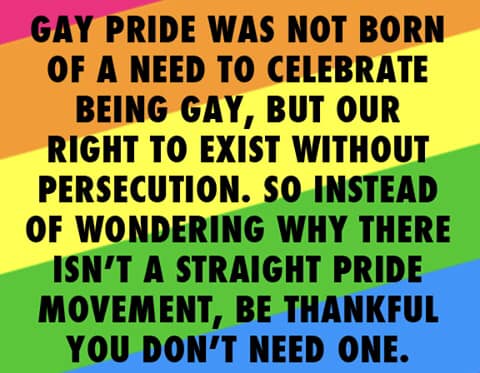
To all those who feel conflicted about Pride, I would say: I feel the same. I don’t like what Pride has become. I don’t agree with all its values. But in spite of this, it’s still true that many people who celebrate Pride just want to support LGBTQ people’s basic human right to life, liberty and security of person—that is, their right to exist free from violence, persecution and abuse. And that is a cause that I as a Christian can fully get behind, not just for LGBTQ people but for everyone.
The rainbow in Christianity is a token of God’s protection of all earthly life. The rainbow symbolizes God’s covenant with the earth, to show mercy toward all earthly life, both animals and humans, both good and evil (Genesis 9:12-17). It’s a symbol of the basic right to life shared by all as God’s creatures. Therefore, from a Christian standpoint, I think the rainbow, when used rightly, is a fitting symbol of the basic human rights and dignity shared by all mankind regardless of one’s views on sexuality and morality. The rainbow does not, according to the Bible, belong to God’s people only or to “good people” only—it belongs to every human being and creature on this planet. Everyone has basic God-given, natural rights that must be respected.
In the spirit of Jesus, Gandhi, Martin Luther King Jr. and others who upheld through their words and actions the basic human dignity of all, let us do the same, not by provocative crusades and selfish display, but by sharing a meal and a respectful conversation with one’s opponents.
This is my testimony. What is yours? Feel free to share in the comment section below!


Leave a comment