
Kendel's Messiah

A testimony unfolding


Pride and Dignity

As a gay man, I’ve always felt conflicted about “Pride” both as a movement and as a name. To quote PsychCentral.com:

Pride often exudes an arrogance and egotism that repels people. Pride is precarious and easily punctured. Someone insults us, leaves us, or injures us in some way and we feel devastated. Dignity contains a humility and gratitude that invites people toward us.

Pride’s condonement of sexualized behavior. Growing up in the Church, one of the things that made it so difficult for me to accept and respect myself as a gay man was the Pride parade. I didn’t want to be associated with Pride. The sexualized, licentious expressions condoned by the Pride movement is a stumbling block and a byword in many Christian circles. I’ve experienced firsthand how Pride has reinforced people’s prejudices against LGBTQ individuals.

But the Pride movement doesn’t seem to care. The movement has thrived on pushing boundaries. Criticism of Pride is seen as bigotry, intolerance, homophobia and discrimination, and many Pride activists use identity politics as license to continue their course of open vulgarity. “Look at the persecution that our forerunners and activists have had to endure, and what they have accomplished,” many say. “You should be grateful to them!”

The vulgarity and sexualized behavior condoned by the Pride movement might be legal according to state law. But is it right? Is it beneficial to the cause? It’s impossible to know what might have been accomplished for LGBTQ rights globally with a healthier celebration of Pride.

This is the same kind of self-victimization that is seen in so many abusive religious leaders once they have been called out for their abuse. The same argument is used: “Look at all the positive change that our leaders have accomplished! Look at the cause they’re fighting for! Look at how they have been persecuted! How dare you criticize those who have devoted their lives to the cause!”

Do the ends justify the means? Do good intentions, persecution or a just cause justify bad and reckless behavior?

Hypocrisy and bigotism are not illegal according to state law; nor is licentious, provocative behavior. Both religious bigots and vulgar activists have the legal right to be reckless and offensive. Does that make it ethical or helpful to the cause?

While some progress indeed has been made concerning the recognition of human rights, it is impossible to know how much farther we might have come in terms of worldwide justice and peace for LGBTQ people if the indecent, sexualized aspects of the Pride movement were not encouraged or condoned. The Pride movement has indeed won a large following in a short amount of time in the West; but the political pendulum is now turning in the other direction. If you criticize Pride or LGBTQ people for their unhealthy behaviors or questionable ideologies, you’re quickly labeled as a bigot. People are starting to get fed up with that, understandably—because it’s just not true.

The true cause behind Pride. Just as I believe the Christian movement led by Jesus Christ in the beginning started with a genuine desire to unselfishly serve God and mankind rather than the desire for political power and control (as is seen now throughout the institutions of Christendom), I want to believe that Pride as a movement initially was driven, not by gross pride or selfish exhibitionism, but by the pursuit of human rights and dignity. That it started as a pursuit of LGBTQ people’s basic human right to exist without persecution and abuse. Such a cause has nothing to do with “pride” or egotism or exhibitionism. The name “Pride” is therefore really unfortunate and, I hope, wildly inaccurate in terms of what the movement is about.

Pride as a state of mind is not at all about justice—it’s narcissistic and demands recognition at the expense of others, disregarding their sensibilities, conscience, and need to be heard. Dignity, on the other hand, seeks what is best for everyone and earns recognition naturally through humility, unselfish interest, and moral integrity. Pride is loud, demanding, selfish, short-sighted and short-lived. Dignity is meek, inviting, and keeps growing.

Pride as a state of mind (…) is narcissistic and demands recognition at the expense of others, disregarding their sensibilities, conscience, and need to be heard. Dignity, on the other hand, seeks what is best for everyone and earns recognition naturally through humility, unselfish interest, and moral integrity.

In the wake of the shootings at a gay club in Oslo a couple of years ago, I was told by a relative that if someone in their family showed up at their door with a same-sex partner, they’d shoot them. Why they’d shoot them? “Because they’re going to hell anyway,” they said. I refuse to believe that they actually meant it. Why? Because I know what it’s like to be ignorant and fearful. I can sympathize with their fear. Now I’m privileged with an experience and an insight that they haven’t had yet. Now I know better; I know that true peace and real justice are attained only through dialogue, education and mutual respect.

Many people have been taught to fear this or that enemy. The only way to expel this fear and cure the animosity is to act like a friend, to be a friend. And that’s hard. It’s easy to nurture pride and stay enemies: “us vs. them”. It’s easy to hate in return and satisfy one’s own ego. It’s easy to follow one’s animal instincts. It requires sacrifice, patience, discipline, and humility to sit down and share a meal with a person who thinks you’re an abomination. This requires humanity. And the life of Jesus and other Jesus-inspired people such as Gandhi and Martin Luther King Jr. are to me prime examples of what this kind of humanity can accomplish. “Love your enemies, do good to those who hate you, bless those who curse you, pray for those who mistreat you” (Luke 6:27-28, ESV).
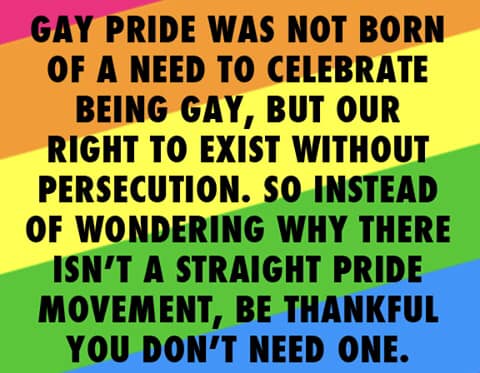
What is the original cause behind the Pride movement, and what has the movement become?

To all those who feel conflicted about Pride, I would say: I feel the same. I don’t like what Pride has become. I don’t agree with many of its values and choice of name. But in spite of this, it’s still true that many people who celebrate Pride just want to support LGBTQ people’s basic human right to life, liberty and security of person—that is, their right to exist free from violence, persecution and abuse. And that is a cause that I as a Christian can get behind, not just for LGBTQ people but for everyone.

The rainbow in Christianity is a token of God’s protection of all earthly life. The rainbow symbolizes God’s covenant with the earth, to show mercy toward all earthly life, both animals and humans, both good and evil (Genesis 9:12-17). It’s a symbol of the basic right to life shared by all as God’s creatures. Therefore, from a Christian standpoint, I think the rainbow, when used justly, is a fitting symbol of the basic human rights and dignity shared by all mankind regardless of one’s views on sexuality and morality. The rainbow does not, according to the Bible, belong to God’s people only or to “good people” only—it belongs to every human being and creature on this planet. Everyone has basic God-given, natural rights.

In the spirit of Jesus, Gandhi, Martin Luther King Jr. and others who upheld through their words and actions the basic human dignity of all, let us do the same in our own lives, not by provocative crusades and selfish display, but by sharing a meal and a respectful conversation with one’s opponents.

This is my testimony. What is yours? Feel free to share in the comment section below!


Posted

in

,

by

Comments

6 responses to “Pride and Dignity”

  1. Rayfi's Gastronomic Odyssey Avatar

    I want to have an open and respectful conversation about your identity, as I believe it’s important to express my concerns from both a religious and a practical standpoint. Many holy texts, like the Quran and the Bible, provide guidance on human relationships and often highlight traditional views on sexuality. For example, in the Quran, the story of the people of Lot serves as a cautionary tale against same-sex relations, illustrating a perspective that sees such behavior as contrary to divine will. Similarly, the Bible contains verses that express strong condemnation of same-sex relationships. These teachings are deeply rooted in the beliefs of many people who see them as a reflection of God’s intention for human relationships.

    From a pragmatic viewpoint, consider this hypothetical situation: if everyone were to identify as gay, it would ultimately lead to the extinction of humanity. If procreation relied solely on same-sex relationships, there would be no future generations. This scenario underscores the biological necessity of heterosexual relationships for the survival of our species.

    Moreover, normalizing behaviors that some view as wrong can lead to a gradual erosion of societal values. History shows that when harmful practices become widely accepted, they can compromise the moral fabric of communities. Therefore, it’s essential to address these issues seriously and not simply tolerate them, as this can lead to a shift in what society deems acceptable.

    I encourage you to reflect on your choices and consider the possibility of repentance. This isn’t about shaming or rejecting you; it’s about finding a way to align yourself with values that many believe promote both personal fulfillment and societal harmony. Embracing a path of reflection and seeking forgiveness can lead to a deeper understanding of oneself and a sense of belonging within a community that values traditional principles. I hope we can engage in a constructive dialogue about this and explore the potential for personal growth together.

    Like

    1. davidkendel Avatar
      davidkendel

      Hi, there. I appreciate your respectful comment and would like to share my story and my perspectives with you. I suspect that you do not understand the implications of what you are saying, my friend. And I don’t blame you, since many religious people are unaware of what many gay people go through before deciding to come out and seek a same-sex partner.

      Firstly, in order for you to understand that my sexual orientation and my need for a partner is not a choice nor an act of rebellion, please read my post “God’s Acceptance”.

      Secondly, I would like to point out that the story of Sodom is not a story about same-sex partnership and love, but about oppression and rape. All the men in the city demanded to have sex with Lot’s guests – this has nothing to do with love or partnership.

      The prophet Ezekiel explains quite plainly the reason for God’s punishment of the city:

      “Behold, this was the guilt of your sister Sodom: she and her daughters had pride, excess of food, and prosperous ease, but did not aid the poor and needy. They were haughty and did an abomination before me. So I removed them, when I saw it.” (Ezekiel 16:49-50, ESV)

      Notice that the main issue was not same-sex partnership, but pride, oppression and sexual perversion (rape of other men).

      While this story does mention homosexual acts in the context of oppression and perversion, it does not speak of homosexual relations in the context of loving commitment. Therefore, I do not believe this text can be interpreted as to judge gay people today who are seeking a partner for mutual love and commitment. This is beyond the scope of this text.

      Thirdly, I never said that I want to normalize homosexuality. What I argue is the homosexuals should not be treated disrespectfully. Do you agree that gay people have basic human rights like everyone else? Jesus himself associated with sinners as their friend, not because he condoned their sin, but because he saw their worth and also their need of God’s grace. Respecting people cannot erode societal values since respect in itself is an important and fundamental value for society (social contracts) to exist. The truth is that people who fall outside the norms of society will always exist – therefore, if our society is going to function without violence, oppression and bloodshed, respect is essential. Respect does not necessite full agreement – but it does require kindness and tolerance toward those we disagree with on moral issues.

      You speak of repentance as if I have not tried to do this for years before coming out and accepting myself. As I write in my post “God’s Acceptance”, I tried for years to change and suppress my need for a partner that I could love genuinely. Finally, I became mentally ill and suicidal. I realized that I cannot change myself or live a lie.

      From a pragmatic point of view, would you say that it’s a sin to not have children? Because if everyone decided to stay childless, the world would also be empty. And pragmatically, would you say that the world would be a better place if everyone lived disingenuously or in a mentally unwell/suicidal state for the sake of procreation? What makes a good life to you? What makes a good society? Do you understand that the lack of love and connection can destroy a person’s health? Do you think gay people, who often have been rejected or condemned by their families and friends, choose to be gay because they want to?

      As a Christian, I belive God’s grace extends to the people who fall short of the ideals in the Bible and are sinful but who acknowledge their sin and need for God’s forgiveness. This is illustrated in Jesus’ parable of the tax collector and the Pharisee in Luke 18:9-14, where the tax collector (the sinner) is justified because of his confession and humility rather than the Pharisee, who boasts of his good works.

      I’m interested in hearing your thoughts!

      Liked by 1 person

      1. Rayfi's Philosophical Insights Avatar

        Dear David,

        Thank you for sharing your perspective with such openness. I appreciate the opportunity for dialogue, and I want to approach this with both respect and sincerity.

        Firstly, I believe that life is indeed a test for each of us, and our experiences are varied. Just as some face challenges of desire for violence, theft, or other transgressions, others grapple with their own inclinations. It is our duty to fight against these impulses and adhere to divine guidance, as it is through this struggle that we grow spiritually and find our true purpose.

        The Bible is clear in its teachings, particularly in Leviticus 18:22 and 20:13, where it explicitly forbids same-sex relations. Regardless of how one interprets the story of Sodom, the scriptures provide unequivocal guidance on this matter.

        While your intention may not be to justify such behavior, the narrative you present can inadvertently serve as a validation for those seeking to rationalize actions that many view as contrary to divine will. It is essential to be mindful of how our words may influence others in their understanding of morality.

        In the journey of repentance, true acknowledgment and remorse are vital first steps. Without a genuine admission of one’s actions as sinful, one remains entangled in a struggle against divine will. By holding onto personal interpretations, we may risk placing our understanding above God’s guidance, which can cloud our path to salvation.

        Regarding the notion of being child-free, while it may not be inherently sinful, I believe we must consider the implications of our choices within the broader context of moral responsibility. We are engaging in a discourse about the consequences of actions, are we not?

        Lastly, the goodness of God lies in His guidance, illuminating the path of right and wrong. In Islam, while His mercy is profound, we must remember that we are uncertain of when our time may come. Repentance is a path to forgiveness, yet the opportunity to seek it is finite. Moreover, in Islam, we must be wary of the concept of ‘jariyah/continuous sin’—the notion that our support or justification of others’ sins can burden us with their consequences.

        Let us continue this conversation with an open heart, striving for mutual understanding and respect.

        Like

      2. davidkendel Avatar
        davidkendel

        Hi again,


        I appreciate your intention to turn people to God, I think it’s a beautiful thing when done respectfully and kindly and without judgment and selfish interest.

        I would like to challenge your assumptions that the biblical text is unequivocal in relation to committed same-sex relations. The texts you are referring to in Leviticus are not so clear as people claim – these texts more accurately say that a man shall not “bed with a male [in] a woman’s bed”, as the text reads in Hebrew and Greek. This text has traditionally been interpreted and translated as teaching that all same-sex relations are abominable and unforgivable to God. However, some scholars such as Bruce Wells (link included at the bottom) argue that the text concerns the oppression of the sexual rights of the wives, forbidding the husband to share his wife’s (or wives’) bed with other males (such as male slaves).

        In the face of the suffering that many gay people have experienced in their efforts to live celibately or heterosexually, I think it’s in line with God’s will to open-mindedly reconsider the extent to which God’s mercy can extend. This is not about twisting the word of God to suit human passions, but about seeking to alleviate the suffering of so many conscientious, God-fearing people who in trying to follow God have lost their health and their faith in God. Have you read the stories of religious gay men and women? One must at some point ask oneself: Is the destruction of people’s mental health God’s will? Have we really understood God’s requirements if our teaching breeds mental illness and suicidality among people? The fruit of God’s Spirit is “love, joy, peace, patience, kindness, goodness, faithfulness, gentleness, and self-control” (Galatians 5:22-23, ESV). If our teachings do not bring these fruits in people’s lives, at what point would we be willing to reconsider our doctrines and our interpretations? Jesus said that we should judge prophets (and by extension, their teachings) by their fruit (Matthew 7:15-20). If the fruit is bad, would we never be willing to reconsider our own interpretations regardless of how these impact people? God and His word is indeed infallible – but is our understanding infallible?

        I agree with your conclusion that, by extension, homosexuality is condemned by the guidance in the Bible. Jesus himself condemned divorce and remarriage by reference to how God created mankind in the beginning as male and female to be joined together (Matthew 19:3-6). This implies that homosexuality, like divorce and polygamy, is a departure from the divine will most clearly manifested at the beginning of creation when the world was without sin. However, divorce was tolerated under Moses because of the hardness of people’s hearts, as Jesus explains. Polygamy is also a denature from God’s will and God explicitly condemned the multiplication of wives (Deuteronomy 17:16-17). And yet, polygamy is tolerated in the Old Testament, probably because a husband-less woman was a woman without any rights or children, and was in many ways a dead woman.

        There is a pattern in the Bible where God in His mercy tolerates sinful or less ideal social arrangements in order to avert greater suffering and evil. I argue that while the Bible specifically condemns homosexual perversion and voluntary sin, God’s mercy extends to gay people who are in their efforts to please God are not able to marry heterosexually (thus inflicting suffering on their spouse) nor are able to live celibately with their mental health intact. Jesus did acknowledge that not everyone is able to live celibately, only those who are given this gift by God (Matthew 19:11-12).

        You say that we are called to strive against sin. As a Christian, I also fully believe that we are called to strive against sin – but the difference between you and I lies in our interpretations of what this struggle against sin consists in practically. Your understanding of striving against sin seems to be focus on mankind’s own will-power and ability to resist and overcome sin through his own efforts. But this is not in line with the Christian doctrine of justification and salvation. Islam seems to believe in mankind’s ability to free himself from the hold of sin by obedience to God’s law (correct me if I’m wrong). While Christianity does affirm human free will, it does not affirm mankind’s ability to free himself from sin by his own efforts to keep God’s law, but that this freeing process is God’s gift that is received through faith in Jesus Christ.

        To strive against sin in the Christian sense is not in its essence a striving to understand and obey God’s law, but a striving to draw closer to Jesus and let Him change us in His own time and way. It is impossible for us to bring ourselves into harmony with God’s law because of the profound power of sin over our entire being. Our will is too weak. In the Sermon on the Mount (Matthew 5-7) and in Mark 7:20-23, Jesus testifies to the true nature and universal grip of sin on the human heart: Sin is not merely wrong actions, but wrong thoughts and feelings. Outward obedience to God’s law is of no salvific value when the heart is unchanged. The Jews believed that they were righteous before God because of their strict outward adherence to the written law; but Jesus testified to their sinfulness and wickedness of heart, and their lack of faith in Christ.

        The apostle Paul explains the dynamics of the law, faith and salvation, and he writes:

        “For by works of the law no human being will be justified in his sight, since through the law comes knowledge of sin. But now the righteousness of God has been manifested apart from the law, although the Law and the Prophets bear witness to it— the righteousness of God through faith in Jesus Christ for all who believe.” (Romans 3:20-22, ESV)

        And later:

        “For everyone has sinned; we all fall short of God’s glorious standard. Yet God, in his grace, freely makes us right in his sight. He did this through Christ Jesus when he freed us from the penalty for our sins.” (Romans 3,23-24, NLT)

        Paul also writes:

        “For all who rely on works of the law are under a curse; for it is written, “Cursed be everyone who does not abide by all things written in the Book of the Law, and do them.” Now it is evident that no one is justified before God by the law, for “The righteous shall live by faith.” But the law is not of faith, rather “The one who does them shall live by them.” Christ redeemed us from the curse of the law by becoming a curse for us—for it is written, “Cursed is everyone who is hanged on a tree”— so that in Christ Jesus the blessing of Abraham might come to the Gentiles, so that we might receive the promised Spirit through faith.” (Galatians 3:10-14)

        “Why then the law? It was added because of transgressions, until the offspring should come to whom the promise had been made, and it was put in place through angels by an intermediary. Now an intermediary implies more than one, but God is one. Is the law then contrary to the promises of God? Certainly not! For if a law had been given that could give life, then righteousness would indeed be by the law. But the Scripture imprisoned everything under sin, so that the promise by faith in Jesus Christ might be given to those who believe. Now before faith came, we were held captive under the law, imprisoned until the coming faith would be revealed. So then, the law was our guardian until Christ came, in order that we might be justified by faith. But now that faith has come, we are no longer under a guardian, for in Christ Jesus you are all sons of God, through faith. For as many of you as were baptized into Christ have put on Christ.” (Galatians 3:19-27)

        As a gay man who for years strove to keep God’s laws on sexuality (remain celibate) and had my mental health and my faith in God ruined in the process, I learned what the Christian way to salvation really is. The striving against sin in Christianity is striving to believe in Jesus Christ – in the His righteousness on our behalf, in His grace, power and the growth that He will provide through our faith and connection with Him. The striving to keep God’s law puts the focus on our own self and breeds spiritual egotism, pride and anxiety (which are are violations of God’s law); the striving to live with Jesus Christ and be covered by His grace puts the focus on Him and offers a way out of the egotism, pride and anxiety of building our own righteousness before God.

        “Therefore, since we have been justified by faith, we have peace with God through our Lord Jesus Christ.” (Romans 5:1, ESV)

        The gift of God’s salvation through faith in Jesus creates peace and the love of God in the heart, which in turn transforms the heart and eventually shapes our desires and will, bringing them in line with God’s law and will by His miraculous power. But this change is not a process that can be forced by threats of hell and punishment or by mere willpower. Only God’s acceptance of us as we are now through Jesus and the peace that Christ gives can create this change of heart and make us truly holy. While threats of punishment may force people to submit outwardly (for a time) to God, the heart is unconverted and the person’s inner character remains unchanged and selfish. This is hypocrisy, and is not the kind of worship that God wants. “God is spirit, and those who worship him must worship in spirit and truth,” Jesus said (John 4:24, ESV).

        When the people asked Jesus what God wanted them to do, He replied:

        “Then they [the crowd] said to him [Jesus], “What must we do, to be doing the works of God?” Jesus answered them, “This is the work of God, that you believe in him [Christ] whom he has sent.” (John 6:28-29, ESV)

        The Christian striving against sin is restful because it consists in confession of sin and in faith in God’s forgiveness and His transforming power in our hearts through our faith in the work and merit of Christ:

        “If we say we have no sin, we deceive ourselves, and the truth is not in us. If we confess our sins, he is faithful and just to forgive us our sins and to cleanse us from all unrighteousness.” (1 John 1:8-9, ESV)

        Again, the Christian’s striving against sin is restful when we hear what Jesus said:

        “Come to me, all you who are weary and burdened, and I will give you rest. Take my yoke upon you and learn from me, for I am gentle and humble in heart, and you will find rest for your souls. For my yoke is easy and my burden is light.” (Matthew 11:28-30, ESV)

        The yoke of Jesus is not the yoke of the law (which inflicts punishment), but the yoke of humility and faith (which breathes hope).

        Paul writes:

        
”And to the one who does not work but believes in him who justifies the ungodly, his faith is counted as righteousness.” (Romans 4:5, ESV)


        Notice that Paul does not say that God justifies sin, but that He does justify the ungodly through their faith in Christ. I believe this is because God knows that human beings cannot free themselves from sin – they are fully dependent on His forgiveness, acceptance and help. Jesus payed the price for all of the world’s sins so that the law of God demanding punishment for sin is perfectly fulfilled while those sinners who receive Christ might receive hope, forgiveness, healing and eternal life.

        This is why I as a gay man after years of trying, have stopped outwardly pretending to be something that I’m not inwardly. I’m not at this point heterosexual, and I’m not at this point mentally robust enough to be alone in life. Even Adam, who was created sinless in God’s paradise, was not happy without a human partner by his side – “it is not good that the man should be alone” God said (Genesis 2:18). Today, people are born with various conditions as a result of the brokenness of our world – but the need of human connection and love is still shared by most people today. And while some find fulfillment in friendships, others are not able to do so without sacrificing their health.

        So, while it is good to point people to God’s ideal and law in terms of sexuality, I believe as a Christian that this is not enough. God must forgive our shortcomings and work a miracle in the heart, and this is only accomplished when we believe in Christ’s righteousness on our behalf.

        Link: https://www.academia.edu/42810771/On_the_Beds_of_a_Woman_The_Leviticus_Texts_on_Same_Sex_Relations_Reconsidered

        EDIT: I want to clarify the previous statement: “However, some scholars such as Bruce Wells (link included at the bottom) argue that the text concerns the oppression of the sexual rights of the wives, forbidding the husband to share his wife’s (or wives’) bed with other males (such as male slaves).”

        By “the wife’s bed”, I’m not referring to the physical space (the bedroom) belonging to the woman, but her sexual domain or territory over her husband. The wives of married men had the exclusive sexual rights to their husband – thus, the husband was not allowed to share her sexual territory with other males.

        Like

      3. Rayfi's Philosophical Insights Avatar

        The interpretation of Leviticus 18:22 and its parallel, Leviticus 20:13, has indeed stirred profound debates among scholars. The verse, often translated as “You shall not lie with a male as with a woman; it is an abomination,” stands as a formidable testament in traditional readings against male same-sex relations. However, your challenge invites us to dissect the nuances of the original language, framing it within a broader cultural and legal landscape of the ancient Near East.

        The Hebrew phrasing “mishkav ishah”—which some render as “in a woman’s bed”—carries subtleties that, when stripped from their historical veil, might point more to societal structures than absolute moral decrees. This perspective suggests that the focus was on protecting a woman’s sexual prerogatives, ensuring that the marital bed, a symbol of covenant and procreation, remained untainted by rivalries or breaches, including with subservient males.

        However, the traditional counterpoint maintains that this commandment transcends marital fidelity, touching the essence of permissible unions. Ancient Israel’s legal codes, meticulously aligned with notions of divine order, were believed to reflect more than social protocols; they mapped boundaries of holiness, distinguishing Israel from its neighbors who engaged in practices deemed defiling. The gravity of calling an act “to’evah” (abomination) underscores an intrinsic boundary meant to guard the sacred image of creation as portrayed in Genesis: male and female, complementary and bound in covenant.

        While scholars like Wells provide a vital lens to explore societal aspects, the longstanding interpretations draw strength from continuity across Jewish and Christian thought, where this verse is not isolated but resonates with theological echoes found in Pauline writings and traditional ethics.

        It is, therefore, crucial to hold space for inquiry without neglecting the sacred text’s depth, weighed against centuries of understanding. In the tension between compassion and conviction, respectful dialogue can yield insights that honor both scholarly integrity and the weight of sacred tradition.

        The Islamic and Christian perspectives on the human-divine relationship reveal nuanced differences in how each tradition perceives divine engagement. In Islam, life is often viewed as a series of tests from Allah, designed to assess the believer’s patience, self-control, and submission to divine will. When faced with trials, Muslims are encouraged to exercise restraint and seek repentance should they falter, embodying the roles of the tested and the humble servant before an omnipotent Creator.

        In contrast, Christianity, especially in some interpretations, sometimes emphasizes a more personal, interactive relationship with God, where believers may express desires or even expectations for God to intervene in specific ways—such as performing acts A or B—to foster spiritual growth or improve circumstances. This reflects a perception of God as an intimate Father who responds actively to the needs of His children.

        However, this expectation can lead to inconsistency in the role of humanity within the Christian framework, which may result in a failure to effectively guide believers. When the divine relationship becomes transactional, where human beings demand action from God rather than focusing on their own spiritual journey and responsibilities, it can undermine the transformative potential of faith.

        Thus, in Islam, the relationship between humans and God is distinctly clear: Allah is the tester, and humans are His subjects, with obedience as a central virtue. In some strands of Christianity, however, the dynamic can sometimes appear as a dialogue where believers seek and expect divine action for their betterment. This inconsistency can impede the guiding role of Christianity, as the emphasis shifts from personal growth and accountability to external demands placed upon God. Both views, though different in approach, underscore profound reverence for the divine, each enriching the understanding of faith’s role in guiding human conduct.

        Like

      4. davidkendel Avatar
        davidkendel

        This text is AI-generated. I’m not interested in interacting with a robot. If you’re not able to defend your views and beliefs using your own words, I think you should reconsider them.

        Like

Leave a comment